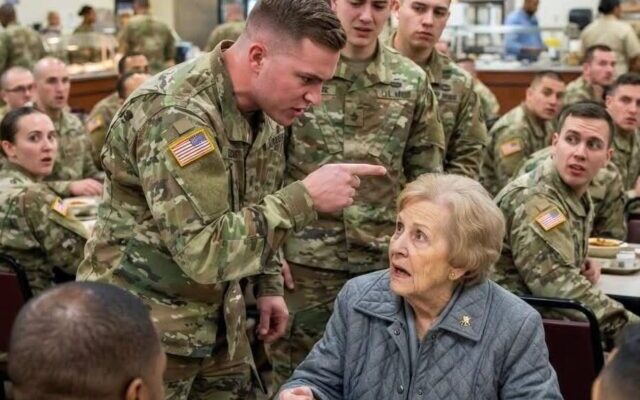
I was eating a bowl of chili by myself in an Army dining hall when a young sergeant with arms like fence posts leaned over my table. “Hey, Grandma. What was your rank back in the Stone Age?”
I refused to look up.
I had driven forty long minutes just to enjoy that bowl of chili.
 “I’m speaking to you, ma’am.”
Three soldiers stood before me. The one leading the confrontation looked no older than twenty-seven. He was broad-shouldered, intimidating, and carried himself like someone who had never been told no.
His name tape read REESE.
Staff Sergeant Reese.
My name is Quinn Braddock. I’m eighty-one years old, living alone in a little yellow house in Clarksville, Tennessee. I spent thirty-one years caring for children as a school nurse. But long before those years, my life had taken a very different path.
That Thursday, I was quietly enjoying lunch in the dining hall at Fort Campbell, Kentucky.
I wore my favorite gray coat and comfortable church shoes. Around me sat hundreds of young soldiers, most young enough to be my grandchildren.
“This is a military installation,” Reese snapped. “You need permission to be here. Or did you wander over from a nursing home hoping someone would give you a free meal?”
His companions burst into laughter.
Slowly, the entire room fell silent. Conversations faded, and even the clinking of silverware seemed painfully loud.
Everyone was watching, pretending not to.
I gently placed my spoon beside my bowl.
That small gesture only seemed to fuel his anger.
He slammed his tray onto the neighboring table and leaned toward me, planting both hands against the surface.
“Look at me when I’m talking! We have standards here. People can’t just walk into my dining hall whenever they please. So tell me, who are you, and why are you here?”
I glanced at the young man, then at the insignia on his uniform.
I remained silent.
My visitor’s pass was safely tucked inside my purse, but I wasn’t about to let a disrespectful young sergeant intimidate me.
I calmly lifted my glass and took another sip.
His expression darkened.
“Get up,” he ordered. “You’re coming with me to the gate.”
I didn’t move.
Then his eyes suddenly settled on the small brass pin attached to my gray coat.
A blue shield with a white bird.
His expression changed.
“Where did you get that?” he demanded.
“That belongs to my battalion! Men have sacrificed their lives for that insignia. Take it off!”
I looked directly into his eyes.
“No.”
It was the first word I had spoken.
He threatened to remove it himself, but I gently stopped a young soldier who had risen to defend me.
Then I looked toward the wall behind him.
“Sergeant,” I said quietly, “before you lay a hand on me, I want you to turn around and read the words painted on that wall.”
Full story in the comments 👇👇
For a moment, Sergeant Reese didn’t move.
Then, slowly, he turned toward the wall.
The words were simple, painted in large blue letters:
“WE HONOR THOSE WHO SERVED BEFORE US.”
His smile disappeared.
I watched him read them again, this time more carefully.
“My name is Quinn Braddock,” I continued. “Fifty-six years ago, I served with the very battalion whose insignia you wear so proudly. I was a combat medic. I carried wounded soldiers through gunfire, held dying boys’ hands, and wrote letters to mothers who would never see their sons again.”
The room was completely silent.
I reached into my purse and placed an old photograph on the table. It showed a much younger woman wearing the same blue shield.
“That girl was me, Sergeant.”
His face went pale.
At that moment, an older colonel entered the dining hall. He noticed the photograph, stopped in his tracks, and immediately recognized me.
“Captain Braddock?” he whispered.
I nodded.
He approached, stood straight, and saluted.
Then another soldier rose. And another.
Within seconds, nearly two hundred young men and women were standing.
Reese lowered his eyes. His hands trembled.
“Ma’am, I didn’t know,” he whispered.
I gently shook my head.
“That’s the problem, son. You shouldn’t have needed to know my history to treat me with dignity.”
He swallowed hard, fighting back tears.
I picked up my spoon and looked at my bowl.
“My chili is getting cold.”
A few nervous smiles appeared around the room.
The colonel ordered Reese to apologize and report to his commanding officer.
But before I left, I told him something I hoped he would remember for the rest of his life:
“Your uniform gives you authority, Sergeant. But your character determines whether you’ve earned respect.”
That afternoon, I finally finished my lunch.
And for the first time in a very long while, I felt that the sacrifices of my generation had not been forgotten.