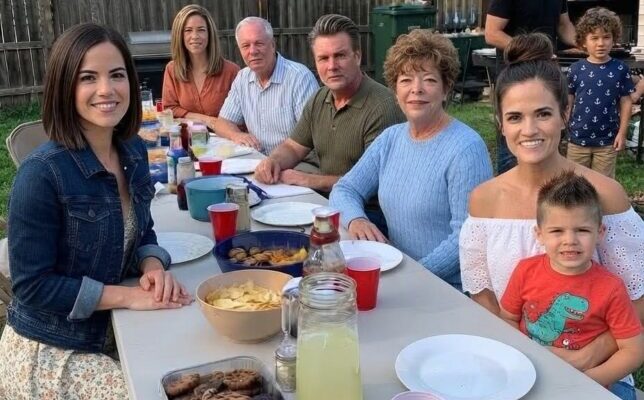
At my dad’s 71st birthday picnic, my mother looked directly at my eight-year-old son, Noah, and said, “Next time, leave him at home.”
She didn’t whisper.
She didn’t care who heard.

And everyone heard.
Noah froze, his plastic fork suspended halfway to his mouth. He was wearing his favorite dinosaur shirt and had spent the entire afternoon trying his hardest not to bother anyone.
Earlier, my brother’s dog had knocked over his lemonade. Noah immediately apologized, even though it wasn’t his fault, then quietly cleaned the mess while everyone else laughed.
That was Noah—always trying to make himself smaller so nobody would regret having him around.
I stared at my mother.
“What did you just say?”
She calmly wiped her mouth.
“I said what everyone is thinking. He changes the atmosphere whenever he comes.”
My heart sank.
This wasn’t new.
For years, Mom had hidden her cruelty behind little jokes and careless remarks. Everyone excused her because she was Grandma. But children don’t forget the words adults tell them to ignore.
I looked around the table.
My siblings looked away.
My aunts suddenly became interested in their phones.
My father said nothing.
Not one person defended my son.
Then a chair scraped loudly against the pavement.
Lily, my seventeen-year-old daughter, stood up.
She hated confrontation. She hated attention. But now she looked straight at Grandma and said,
“Say it again.”
The picnic went completely silent.
Mom blinked. “Excuse me?”
“Look Noah in the eyes and tell him he isn’t welcome because his presence makes you uncomfortable.”
My mother told her to stay out of “adult conversations.”
Lily’s voice trembled, but she didn’t back down.
“This stopped being an adult conversation the moment you humiliated an eight-year-old in front of his entire family.”
I reached beneath the table and squeezed Noah’s hand. His tiny fingers tightened around mine.
Then Lily reached into her backpack and pulled out her phone.
My mother’s face changed.
Lily placed the phone on the table.
An audio recording was already open.
“You told me I was old enough to understand why Noah shouldn’t be invited anymore,” Lily said.
Mom went completely still.
Then Lily pressed play.
And suddenly, everyone was about to hear what Grandma had been saying about Noah when she thought nobody was listening. Full story 👇
Lily pressed play.
My mother’s voice filled the silence.
“I don’t understand why Marissa keeps bringing him. He’s strange. The other children notice it. Honestly, I think everyone would enjoy family gatherings more if he stayed home.”
Noah’s eyes filled with tears.
I felt something inside me break.
But before I could speak, my father stood up.
He looked at Mom with an expression I had never seen before.
“Is that what you really think about our grandson?”
Mom’s face hardened.
“I was only being honest.”
“No,” Dad said quietly. “You were being cruel.”
For the first time, my mother had nothing to say.
My brother lowered his head.
Then my aunt began crying.
“I heard some of those comments before,” she admitted. “I just never knew how bad it had become.”
One by one, the family started speaking.
Apologies Noah should have heard years ago came pouring out.
But Noah wasn’t listening anymore.
He was looking at me.
“Mom… did Grandma really not want me here?”
I pulled him into my arms.
“You never have to earn a place in this family, sweetheart. You belong wherever I am.”
Lily wrapped her arms around both of us.
Then Dad walked over and knelt beside Noah.
“You are my grandson,” he said. “And I want you at every birthday, every holiday, every ordinary Sunday dinner. If someone has a problem with that, they can leave.”
Mom quietly picked up her purse.
Nobody stopped her.
As she walked away, Noah whispered, “Did I ruin Grandpa’s birthday?”
Dad smiled through his tears.
“No, buddy. You reminded us what family is supposed to mean.”
That day, the birthday cake was served late.
The burgers got cold.
And nobody cared.
Because sometimes a family doesn’t fall apart when the truth comes out.
Sometimes, for the first time, it finally begins to heal.