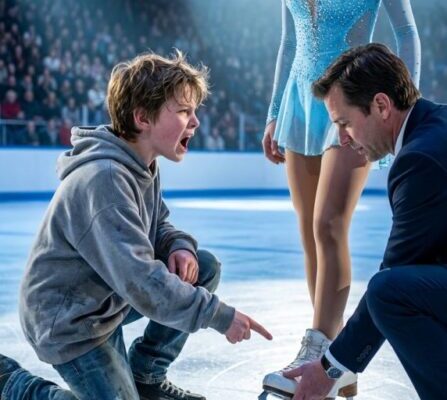
“She can’t jump!” the boy shouted as he slid across the ice. “Her blade is cracked!”
The arena erupted with boos.
“Get him out of here!” someone yelled.

Security rushed toward the boy while thousands watched in shock. At center ice stood sixteen-year-old Madison Reed, America’s rising figure-skating star, frozen under the bright lights.
A few feet away stood the boy everyone believed had just ruined the biggest moment of her life.
He looked exhausted and cold. His oversized hoodie was soaked with snow, his gloves were torn, and his trembling hands were bright red from the freezing weather.
In the front row, Madison’s father, billionaire Daniel Reed, jumped to his feet.
“Get him away from my daughter now!”
But the boy didn’t back down.
Pointing at Madison’s right skate, he pleaded, “She’ll fall if she jumps. The blade is splitting near the heel.”
The coach rolled his eyes. “You think you know more than professionals?”
The crowd laughed. Phones came out to record the scene.
But Madison felt a knot tighten in her stomach.
During practice, she had noticed a tiny wobble when landing a spin. She’d ignored it.
Now she wasn’t so sure.

The boy dropped to his knees.
“Please,” he begged. “Just check the blade.”
Reluctantly, the coach knelt beside her skate.
His expression changed instantly.
A thin crack ran through the blade, nearly invisible beneath the rink’s bright reflections.
A gasp swept through the arena.
Madison went cold.
Her final move was the hardest jump of her career. One bad landing could have shattered her ankle—or worse.
Daniel stared at the damaged skate, stunned.
“How did you see that?”
The boy looked down.
“My mom used to sharpen skates,” he said quietly. “I saw the reflection bend.”
Moments earlier, the crowd had mocked him.
Now the arena was silent.
Madison skated over and looked him in the eye.
“You saved me,” she whispered.
He shrugged. “I just didn’t want you to get hurt.”
The audience began to clap.
Then cheer.
Soon the entire arena was on its feet.
Fighting back tears, Madison removed her silver medal ribbon and placed it around his neck.
“What’s your name?”
The boy hesitated.
“Eli.”
Madison smiled.
“Well, Eli, you’re the reason I’m still standing here.”
But before anyone could say another word, an arena technician ran toward Daniel Reed, holding a tablet with panic on his face.
“Sir,” he gasped, “you need to see this.”
Daniel looked at the screen—
and instantly turned pale.
…Full story in the first comment 👇👇👇
Daniel stared at the tablet, his face draining of color.
“Where did you get this?” he asked, his voice barely above a whisper.
The technician swallowed hard.
“It just came in from the maintenance team.”
Madison stepped closer.
On the screen was a security-camera image taken less than an hour before the competition. It showed a man crouched beside the skaters’ equipment area.
The man was holding a tool against Madison’s skate.
The image was blurry—but not blurry enough.
Madison’s heart pounded.
“Who is that?”
The technician zoomed in.
A collective gasp spread through the people gathered around them.
The man worked for the arena.
And according to the timestamp, he had access to Madison’s skates just minutes before she stepped onto the ice.
Police officers already assigned to the event were called immediately.
Within an hour, investigators discovered something even more disturbing.
The crack in the blade wasn’t caused by normal wear.
It had been deliberately cut.
Someone had sabotaged the skate.
The news spread quickly through the arena and across social media.
Fans were horrified.
Reporters flooded the venue.
But amid all the chaos, one fact remained impossible to ignore:
If Eli hadn’t spoken up, Madison would have attempted the jump.
And she almost certainly would have been seriously injured.
A few days later, Madison invited Eli and his mother to a private ceremony at the rink.
There were no flashing cameras this time.
No roaring crowd.
Just a small group of people who wanted to thank the boy who had the courage to speak when nobody wanted to listen.
Madison handed him a framed photo from that night.
Across the bottom she had written:
“Heroes don’t always wear medals. Sometimes they wear torn gloves.”
Eli smiled for the first time.
A local skating foundation, inspired by his story, offered to help his family. Donations poured in from strangers around the country.
His mother found stable work.
Eli returned to school.
Months later, Madison won a national championship.
When reporters asked what motivated her most, she didn’t mention trophies or titles.
She pointed to a young boy sitting in the front row.
“That’s Eli,” she said. “He reminded me that courage isn’t about being the strongest person in the room. It’s about doing what’s right, even when everyone is against you.”
The crowd rose to its feet.
And this time, the loudest applause wasn’t for the champion on the ice.
It was for the boy who refused to stay silent and saved a life.