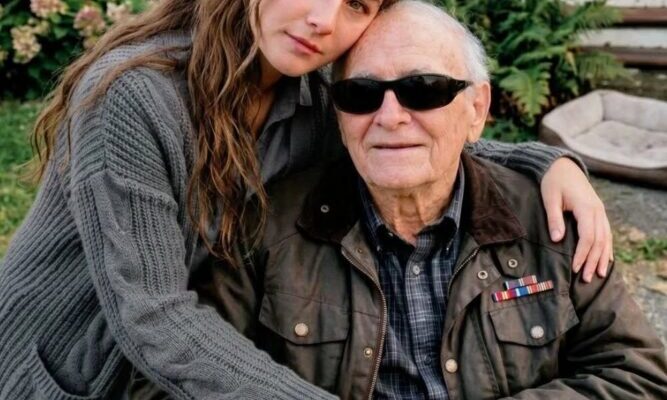
I was hired to spend every Sunday with a blind, lonely veteran—pretending to be the granddaughter who had abandoned him. But after he died, his lawyer looked at me and said, “Before Walter passed away, he left one final instruction about you.”
Three years ago, my life was falling apart.
I was struggling through college while working every extra shift I could find. At home, my single mother was doing everything she could to care for my younger brother, Noah, whose serious health problems meant endless doctor visits, treatments, and medical bills.
One night, I walked into the kitchen and saw my mother staring silently at a hospital bill. She folded it, placed it beneath a pile of unpaid bills, and lowered her head.
It was the first time I had ever seen her look defeated.

That night, after everyone was asleep, I searched online for more work. Anything that could help.
That’s when I found a strange ad.
A wealthy family was offering excellent pay for a young woman to spend Sundays with an elderly blind veteran. There was only one condition:
She had to pretend to be his granddaughter.
The idea felt wrong. But when I looked at the medical bills beside me, I clicked “Apply.”
A week later, I got the job.
The veteran’s daughter explained that her father had lost his eyesight years earlier, and his real granddaughter had disappeared from his life.
“He asks about her all the time,” she said softly. “We just don’t want him to feel forgotten.”
The following Sunday, I nervously knocked on his door.
When he heard my voice, his face lit up.
“There you are,” he said warmly.
My throat tightened.
“Hi… Grandpa.”
At first, every visit felt like a lie. I was terrified he’d discover the truth.
But he never questioned me.
Instead, he shared stories about his military service, the love of his life, and the lessons he’d learned over a lifetime.
Week after week, our bond grew stronger.
What started as a job slowly became something real.
I stopped visiting for the paycheck.
I visited because I genuinely cared.
Somehow, that lonely veteran became one of the most important people in my life.
Then his health began to fail.
One afternoon, he squeezed my hand and said something I’ll never forget:
“You made my final years worth living.”
A few months later, he passed away.
At his funeral, I cried like I had lost a family member—because that’s exactly what it felt like.
Then, a week later, I received a call from his lawyer.
When I arrived at the office, several family members were already there. The room was tense.
The lawyer opened a folder, looked directly at me, and said:
“Before Walter Harrison passed away, he left one final instruction about you.”
The room fell silent.
Then the lawyer revealed a secret that left everyone completely stunned… 👇👇👇👇
Everyone turned toward me.
My heart raced as the lawyer began reading Walter’s letter.
“You may be surprised to see Emily here. She wasn’t my biological granddaughter. But I want you to know something—I knew that from the very beginning.”
The room filled with gasps.
Walter knew.
“The moment she walked into my house, I knew she wasn’t the granddaughter I remembered. Blindness doesn’t mean blindness to people. I recognized a different voice, different footsteps, a different presence.”
Tears filled my eyes.
All those Sundays, all those conversations—he had known the truth the entire time.
“At first, I accepted the arrangement because I was lonely. But soon Emily stopped pretending. She became herself. And she brought more kindness, love, and companionship into my life than I ever expected.”
The room fell silent.
Then came Walter’s final wish.
“A portion of my estate will be placed into a trust for Noah Carter’s medical care and education. No child should suffer because his family cannot afford help.”
The trust contained $200,000.
I broke down.
That gift changed everything. Noah got the care he needed. My mother could finally breathe. Our future suddenly felt possible.
Then the lawyer handed me one last letter.
“Emily, thank you for every Sunday. Thank you for treating an old blind man like he still mattered. Family isn’t always the people we’re born with—it’s the people who choose to stay. You chose to stay. That made you my granddaughter in every way that counts.”
Three years later, Noah is healthy, I graduated college, and life is finally good.
And every Sunday, I still visit Walter’s old house.
I sit in his favorite chair and tell him about my week, about Noah, about life.
Sometimes, when the wind rustles through the trees, I can almost hear him asking,
“How’s your brother doing?”
And I always smile.
“He’s doing great, Grandpa.”