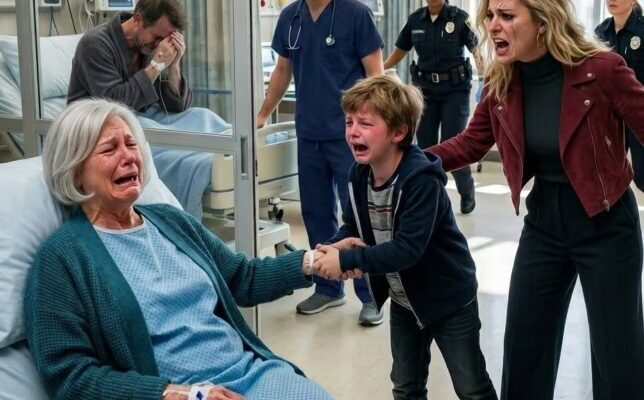
My son was fighting for his life, and a kidney transplant was his only hope. My daughter-in-law looked at me and said harshly, “You have to do this—you’re his mother!” Than my 9-year-old grandson burst into the room and cried out, “Grandma, should I tell everyone the real reason Dad needs your kidney?”
I turned to see my nine-year-old grandson, Ethan, running toward me, tears streaming down his face. He pushed past a nurse and grabbed my trembling hand as though he was afraid he might never get another chance.
“Ethan!” his mother shouted. “Stop!”
But the boy ignored her.
His small hands shook violently as he looked up at me with terrified eyes.

“Grandma,” he whispered, his voice breaking, “should I tell the truth about why Dad really needs your kidney?”
The room fell silent.
Every sound seemed to disappear.
My heart pounded in my chest as I stared at him.
“What truth, sweetheart?” I asked softly.
Across the room, Rebecca’s face turned ghostly white.
“Ethan,” she snapped, panic flashing in her eyes, “don’t say another word.”
But it was too late.
Tears spilled down the boy’s cheeks as he stepped closer to me.
“Dad told me never to tell anyone,” he cried. “He said Mom would send me away if I did.”
A chill raced through my body.
The doctors exchanged uneasy glances.
Then Ethan blurted out the words that stopped everyone in their tracks.
“Dad didn’t get sick by accident!”
And in that instant, the surgery, the transplant, and everything I thought I knew about my son suddenly felt like a lie. 👇👇👇
Dr. Patel’s calm voice was more frightening than a shout.
“Security. And notify administration. No one moves this child.”
Rebecca froze.
Holding Ethan close, Margaret felt him trembling.
“Tell us what you mean,” Dr. Patel said gently.
After looking to his grandmother for reassurance, Ethan finally spoke.
“Dad took pills and injections. Mom said nobody could know because Grandma wouldn’t help anymore.”
Rebecca scoffed, but Ethan’s fear turned into anger.
“You said they were vitamins. I saw the labels. Dad got sick, and you told him to hide it before Grandma came.”
The room went silent.
As Ethan described hidden drugs, steroid use, and conversations about keeping information from doctors, Dr. Patel’s expression hardened.
Looking through the glass, Margaret saw Daniel watching. Not confused—afraid.
“Daniel,” she whispered.
He turned away.
Dr. Patel spoke carefully. “Based on this information, we cannot proceed. Your consent may not have been fully informed.”
Rebecca exploded. “You’re letting him die because of a child’s story?”
“No,” Dr. Patel replied. “We’re investigating whether important medical information was concealed.”
Margaret looked at Rebecca.
“You knew.”
Rebecca didn’t deny it.
“I knew he needed help. And you had what he needed.”
“No,” Margaret said. “You lied.”
When Daniel pleaded from his hospital room, Margaret finally saw the truth: he wanted her kidney, but not accountability.
She removed her surgical cap.
“I’m not doing the surgery today.”
Rebecca shouted, “You selfish old woman!”
For the first time, Margaret didn’t move toward her son. She stayed exactly where she was.
The investigation confirmed Daniel had hidden substance abuse and medical history that could affect transplant eligibility. Margaret learned she had every right to refuse donation.
Her first concern was Ethan.
After he revealed years of pressure and secrets, child-protection authorities became involved. An emergency plan allowed Ethan to stay with Margaret while the case was reviewed.
Daniel eventually admitted the truth.
“I was under pressure,” he said.
“You made your son carry that burden,” Margaret answered.
Later, alone with him, she set a boundary.
“I’ll support your treatment. I’ll sit beside you during dialysis. But I won’t give you my kidney while you’re lying.”
For the first time, Daniel had no argument.
Over the following months, Daniel entered treatment and began taking responsibility for his actions. Ethan remained with Margaret, where he finally felt safe.
A year later, Daniel had documented sobriety and was reconsidered for the transplant list through the normal process.
He apologized to Ethan.
“You did the right thing by telling the truth.”
The tension in Ethan’s shoulders finally eased.
That night, Margaret found a note on her kitchen table:
Grandma, I was scared when I told the truth. But you still loved me. So now I know truth does not make love disappear.
Margaret cried quietly as she read it.
She had gone to the hospital prepared to give away a kidney.
Instead, she reclaimed something she had nearly lost—herself.
And in doing so, she taught her grandson that love should never require silence.