I thought I was taking my daughter to a routine dental appointment. By the end of the day, I was sitting inside a police station, holding a note that changed everything
It started with a toothache.
My ten-year-old daughter, Sophie Carter, had been complaining about pain in one of her back teeth for days. I assumed it was something simple and booked an appointment with our family dentist.
Then Michael surprised me.
“I’ll come too,” my husband said, grabbing his keys.

That should have been my first warning.
Michael never volunteered for appointments. School meetings, doctor visits, activities—he always found a reason to stay away. But this time, he insisted.
At the clinic, Sophie seemed unusually nervous. She sat quietly beside me, constantly glancing toward her father.
Not for comfort.
Almost as if she was afraid of him.
When we entered the exam room, Dr. Nathan Bennett greeted us warmly and began checking her teeth.
Then he noticed it too.
Every time Sophie answered a question, she looked at Michael first.
And Michael never took his eyes off her.
Watching.
Listening.
Controlling the room without saying a word.
“You can relax,” I joked. “It’s only a dental appointment.”
“I’m just supporting my daughter,” Michael replied.
But something about his answer felt rehearsed.
After examining Sophie, Dr. Bennett suddenly grew serious.
“I’d like to take some X-rays.”
While Sophie was out of the room, an uncomfortable silence settled between us.
“Is something wrong?” Michael finally asked.
Dr. Bennett slowly removed his gloves.
“That depends.”
“On what?”
The dentist looked him straight in the eye.
“On the cause of the injury.”
A chill shot through me.
Michael laughed nervously.
“It’s a toothache, Doctor. Not a criminal case.”
But Dr. Bennett didn’t smile.
“We’ll know more after the X-rays.”
Minutes later, Sophie returned looking pale and shaken.
And for the first time, I realized this visit had nothing to do with a simple toothache.
Something was terribly wrong.
Before we left, Dr. Bennett would secretly place a folded note into my hand—a message so disturbing it would send me directly to the police station.
👇 LIKE THIS POST AND COMMENT “YES” TO READ PART 2
The X-ray only took a few minutes.
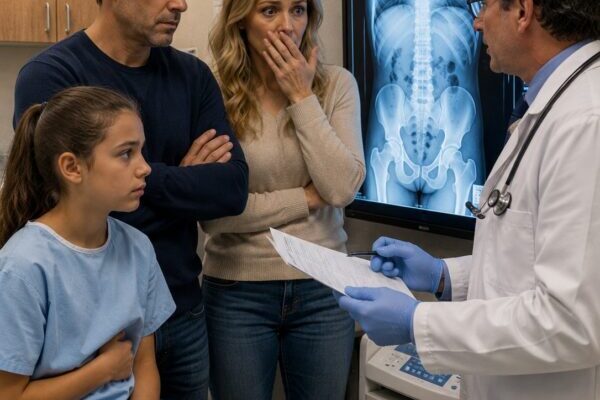
When Sophie settled back into the chair, she sat perfectly still while Dr. Bennett examined the image displayed on the monitor.
The room remained silent.
Then he pointed toward an area near the root of a tooth.
“There it is.”
I leaned forward.
“What exactly am I looking at?”
“A fracture,” he explained. “The root has been cracked.”
My stomach knotted.
“A cavity?”
“No.”
He shook his head.
“This wasn’t caused by decay.”
His eyes stayed on the image.
“This type of damage is usually caused by force.”
The word seemed to linger in the room.
Force.
I turned toward Sophie.
“Sweetheart, did you fall?”
She didn’t answer.
“Did someone bump into you at school?”
Nothing.
Then she looked toward Michael.
The same look.
Brief.
Careful.
Evaluating.
Before Sophie could answer, Michael spoke.
“She plays outside all the time. Kids get hurt.”
Dr. Bennett folded his arms.
“Maybe.”
But the look on his face said otherwise.
Sophie gripped the chair tightly. Tears rolled silently down her cheeks.
She wasn’t crying loudly.
She looked scared.
And suddenly, I couldn’t stop thinking about all the little things I’d ignored.
The nightmares.
The mood swings.
The way she sometimes froze whenever Michael entered a room.
I’d always found excuses.
Until now.
After reviewing the X-ray, Dr. Bennett handed me some paperwork.
“Why don’t you schedule the follow-up appointment at reception?” he said.
“I’ll do it,” Michael quickly offered.
“No,” Dr. Bennett replied immediately.
The room fell silent.
“I’d prefer to speak with her mother.”
For a brief moment, I saw Michael’s jaw tighten.
As I gathered my things, Dr. Bennett stepped closer.
His hand brushed my coat pocket.
Deliberately.
When I looked up, he gave me the slightest nod.
Nothing more.
But by the time we left, I could feel something tucked inside my pocket.
A folded note.
And somehow, I already knew my life was about to change.
The drive home felt endless.
Michael kept talking.
Making excuses.
“Kids get hurt.”
“She probably forgot what happened.”
“You know how dramatic children can be.”
I barely listened.
The note felt like a weight in my pocket.
The moment Michael left the house, I locked myself in the bathroom and unfolded it.
There was only one sentence.
Do not leave your daughter alone with that man. Call the police before he knows you know.
My hands started shaking.
Not “be careful.”
Not “watch for warning signs.”
Call the police.
Immediately.
Suddenly, every memory came rushing back.
Sophie refusing sleepovers.
Locking her bedroom door.
Crying after being alone with Michael.
Things I had dismissed for months.
I went upstairs and knocked softly on her door.
“Sophie? It’s Mom.”
When she opened it, her eyes were red from crying.
I sat beside her.
“You aren’t in trouble,” I said gently.
Silence.
Then I asked the question I never thought I’d have to ask.
“Did Michael hurt you?”
Sophie’s body trembled.
She closed her eyes.
And then she nodded.
Once.
That was all it took.
In that moment, my entire world split into before and after.
I didn’t push her for details.
What she shared was enough.
Enough to know she needed protection.
Enough to know I needed help.
I called the police.
Within minutes, officers arrived.
The note, the X-rays, and Sophie’s statements became part of the investigation.
That same night, we left.
Away from Michael.
Away from the house.
Away from the fear.
The weeks that followed were difficult, but Sophie was surrounded by people trained to help children and keep them safe.
Through every interview and every appointment, I stayed by her side.
One evening, she leaned her head against my shoulder and quietly asked:
“Do you think things will ever be normal again?”
I looked at her and answered honestly.
“Maybe not the same normal.”
She waited.
“But I think things can become good again.”
For the first time in weeks, she smiled.
A small smile.
But a real one.
And in that moment, I learned something I’ll never forget:
Sometimes changing a life starts with believing a child.
And sometimes it starts with a single note slipped quietly into a coat pocket.