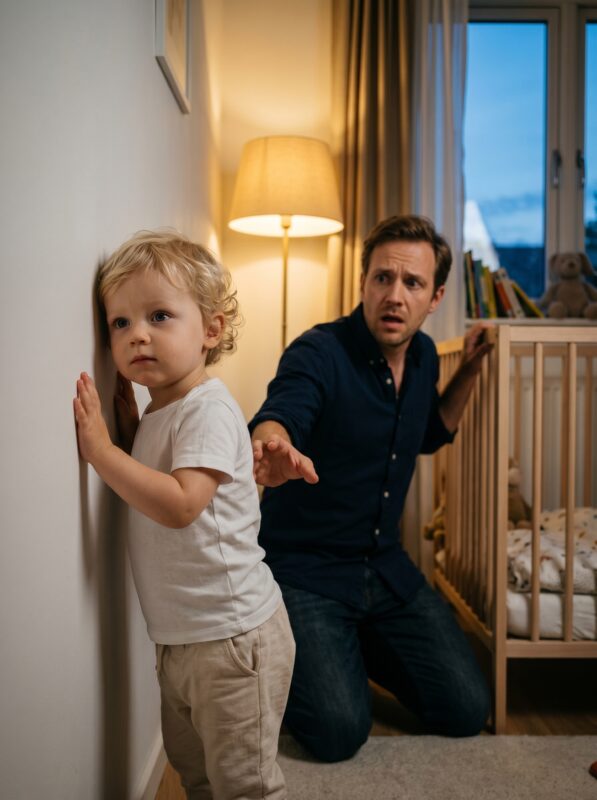
Every hour, without fail, my toddler would walk to the same corner of his room and press his face against the wall.
At first, I brushed it off as one of those strange childhood quirks. Toddlers do odd things all the time, and everyone assured me it was nothing to worry about. But when my son finally explained it months later, I realized there had been more to it all along.
Ethan was just over a year old when the behavior started.
One quiet morning, I watched him toddle across his bedroom floor. He stopped in the far corner, leaned forward, and gently rested his face against the wall. He stood completely still—not laughing, not crying, not making a sound. It was as if he was listening to something only he could hear.
I chuckled and picked him up, assuming it was meaningless.
An hour later, he did it again.
By the end of the day, the pattern was impossible to ignore. Nearly every hour, Ethan returned to that exact spot. The same corner. The same posture. The same eerie silence.
Since my wife had died during childbirth, I had been raising Ethan on my own. I was used to handling challenges by myself—sleepless nights, teething pains, and every milestone in between. But this felt different.
The doctors weren’t concerned.
“Repetitive behavior is common at this age,” one pediatrician told me. “He’s probably just exploring his environment.”
I nodded, but the explanation didn’t sit right with me.
Why that corner?
Discover the rest in the first comment 
I searched for answers. I checked for drafts, hidden pipes, unusual noises, reflections from outside—anything that might draw his attention. I moved furniture, inspected the walls, and even repainted part of the room.
Nothing changed.
Then one night at exactly 2:14 a.m., a scream exploded through the baby monitor.
I bolted from bed and ran down the hallway.
Ethan was standing in the corner again. His small hands were pressed flat against the wall, and his body trembled slightly. He had stopped screaming, but his breathing was fast and uneven, as if he’d woken from a nightmare.
I scooped him into my arms.
“It’s okay,” I whispered. “You’re safe.”
But instead of calming down, he twisted around, desperately trying to look back at the wall.
That’s when I knew I needed help.
The next morning, I contacted a child psychologist named Dr. Mitchell.
“I don’t want to overreact,” I told her, “but it feels like he’s trying to tell me something. Something he can’t put into words yet.”
She came to our house the following afternoon and spent time playing with Ethan. She rolled a ball back and forth, spoke gently, and observed him carefully.
After a while, he stood up.
Without hesitation, he walked directly to the corner and pressed his face against the wall.
Dr. Mitchell watched closely.
“Has anything changed in his life recently?” she asked.
I thought for a moment.
“We’ve had several short-term nannies over the past year. Some stayed only a few weeks. Ethan used to cry whenever certain ones arrived.”
She nodded thoughtfully.
“Would you mind if I observed him alone for a few minutes?”
Reluctantly, I stepped into the hallway and watched through a monitor.
As soon as I left, Ethan calmly returned to the corner.
Several minutes passed in silence.
Then I heard faint sounds—small words that were difficult to make out.
Dr. Mitchell leaned closer.
When she finally emerged from the room, her expression had changed.
“He said something,” she told me.
I frowned. “He’s barely speaking in sentences.”
“I know,” she replied. “But I’m certain I heard him say, ‘I don’t want her back.’”
A chill ran down my spine.
I knelt beside Ethan.
“Buddy,” I asked softly, “who don’t you want back?”
He looked at me with surprising seriousness.
After a long pause, he answered:
“The lady… wall.”
The words hit me harder than I expected.
That night, I dug through old baby monitor recordings stored online. Most had already been deleted, but one video remained.
I pressed play.

The grainy footage showed one of Ethan’s former nannies standing near the corner of his room. At first, nothing seemed unusual. She wasn’t touching him or acting aggressively.
But she lingered there.
For a long time.
She stood facing the wall while Ethan played nearby.
Then something caught my attention.
Ethan stopped playing.
He stared at her.
Slowly, he crawled toward the same corner and pressed his face against the wall—exactly as he still did now.
I paused the video.
Suddenly, the pieces began falling into place.
It wasn’t a ghost story.
It wasn’t anything supernatural.
It was memory.
Somehow, Ethan had connected that corner with a person who made him uncomfortable. Maybe she spent time there repeatedly. Maybe she whispered to herself, stood silently for long periods, or behaved in a way that unsettled him.
Young children often remember experiences differently than adults. Sometimes their bodies remember before they have the words to explain why.
Dr. Mitchell later confirmed the possibility.
“At this age,” she explained, “emotional memories don’t always appear the way adults expect. A place, a smell, or a routine can become attached to a feeling. He’s likely trying to process an experience he doesn’t fully understand.”
I contacted the nanny agency.
The caregiver in the recording had submitted incomplete paperwork and could no longer be reached. There were no official complaints against her, but several inconsistencies in her records raised concerns.
It wasn’t proof of wrongdoing.
But it was enough to make me trust my instincts.
That weekend, I transformed Ethan’s room.
The gray walls became bright yellow. Furniture was rearranged. The once-feared corner was turned into a cheerful play area filled with toys, books, and colorful decorations.
At the same time, Ethan began gentle play-therapy sessions with Dr. Mitchell.
Gradually, the ritual faded.
He stopped visiting the corner.
He slept better.
He laughed more.
He seemed lighter.
Three weeks later, I watched him build a tower of blocks in the middle of the living room. He burst into laughter as it collapsed, scattering pieces across the floor.
No walls.
No corners.
No silent staring.
Just a happy little boy being a child.
On Ethan’s second birthday, I wrapped him in a hug and whispered, “You’re the bravest little guy I know. And you’re safe.”
He grinned and ran off after a balloon.
Even now, years later, I still peek into his room before going to bed.
Not because I’m afraid of what’s hiding in the walls.
But because I learned something important from that experience:
Children don’t always communicate with words.
Sometimes they communicate through patterns, behaviors, and quiet actions that are easy to overlook.
And it’s our job to listen.