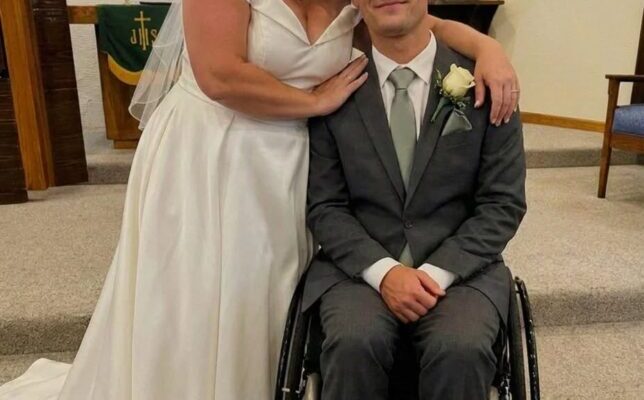
I married the paralyzed 20-year-old millionaire. But on our wedding night, he locked the bedroom door, looked at me with tears in his eyes, and whispered, “There’s no turning back now. It’s time you knew the real reason I married you.”
At forty-three, I had long stopped believing life had anything good left in store for me. Men barely noticed me anymore—and the few who did disappeared the moment they learned my nineteen-year-old daughter, Lisa, had been lying unconscious in a hospital bed since the accident.
“If you can’t afford this experimental treatment,” the doctor told me softly, his voice heavy with sympathy, “your daughter may never open her eyes again.”
Those words shattered me.

From that day on, I worked myself to exhaustion. I took every shift, every job, every opportunity I could find. Sleep became a luxury. Hope became something I had to force myself to hold onto.
When I was offered a position caring for Adrian—the sole heir to one of the wealthiest families in the country—I felt as though heaven itself had thrown me a lifeline.
Adrian was only twenty years old.
The same tragic car accident that had taken both his parents had left him paralyzed from the waist down. Yet despite his unimaginable loss, he carried himself with a quiet kindness that surprised me.
“Please don’t call me ‘sir,’” he told me during my first week after I accidentally ruined his lunch. “You make me sound like a museum exhibit.”
For the first time in months, I laughed.
And somehow, that laugh changed everything.
Over the next six months, I became part of his daily life. I helped him get dressed. Changed his bandages. Sat beside him during agonizing migraines and read stories aloud until he drifted to sleep. Little by little, an unexpected bond formed between us.
Then one stormy afternoon, while rain hammered against the windows, Adrian rolled into the kitchen and found me scrubbing a coffee stain from my sleeve.
“Marry me,” he said.
My heart nearly stopped.
“Adrian…” I stared at him in disbelief. “I’m old enough to be your—”
“You’re not my mother,” he interrupted firmly. “And I’m not joking. Marry me. You’ll never have to worry about money again.”
Every instinct told me to say no.
But every night I watched hospital bills pile higher. Every day Lisa slipped further away. And every minute brought me closer to losing her forever.
So with tears burning in my eyes and desperation crushing my pride, I whispered one word.
“Yes.”
The wedding was painfully simple.
No elegant decorations. No orchestra. No joyful celebration.
Just a handful of witnesses, a wilted bouquet bought at a gas station, and Adrian’s trembling fingers wrapped around mine as we exchanged vows.
There wasn’t even a kiss.
Only silence.
That night, after we returned to his enormous mansion, Adrian asked everyone to leave us alone.
The house felt hauntingly empty.
Then he closed the bedroom door.
Slowly, he wheeled himself toward me.
His face was pale. His hands were shaking.
And for the first time since I’d met him, I saw fear in his eyes.
“There’s no way back now,” he whispered.
My stomach tightened.
“What do you mean?”
Without answering, he reached into a drawer and pulled out a crimson envelope.
Then he handed it to me.
The moment I looked at it, my blood ran cold.
Written across the front, in elegant black ink, was a name I knew better than my own.
My daughter’s name.
Lisa.
Full story in the comments 👇👇👇
“Why do you have this?” I whispered, staring at the envelope.
“Because this is the real reason I married you,” Adrian said.
My hands shook as I opened it.
Inside was the accident report.
Adrian. His parents—dead at the scene.
And one more name under survivors:
Lisa.
My daughter.
The room spun.
“She was in the crash?” I gasped.
Adrian nodded, tears filling his eyes. “Yes.”
I turned the page and saw photos of Lisa’s wrecked car beneath flashing emergency lights. The yellow keychain hanging from her mirror left no doubt.
“You knew,” I said.
“Not when we met. But I found out months ago.”
“Then why keep it from me?”
“Because I was afraid you’d never let me help.”
The next document hit even harder.
While Adrian had been rushed to an elite trauma center, Lisa had been sent to an overcrowded public hospital. Two survivors. Two completely different futures.
Then I found a memo signed by Vivian, Adrian’s aunt.
No further contact with Lisa’s family is recommended. Matter closed.
My chest tightened.
“Matter closed?” I cried. “My daughter was just a liability to her?”
Adrian lowered his head. “Vivian handled everything while I was unconscious.”
“Then why marry me?”
“Because as my wife, you can legally challenge her control, access the trust, and get the treatment Lisa needs.”
I stared at him.
“You gave me a wedding ring instead of the truth.”
“I know,” he whispered. “And I’m sorry.”
Before I could answer, the bedroom door opened.
Vivian stepped inside.
“So,” she said coldly, “he told you.”
The battle that followed ended weeks later at a foundation event.
Standing before a room full of donors, I held up Lisa’s photograph and read Vivian’s memo aloud.
Silence filled the room.
Then Adrian spoke.
“It’s real.”
For the first time, Vivian had no defense.
Soon after, she lost control over Adrian’s medical trust, and the funds for Lisa’s rehabilitation were approved.
Three weeks later, I sat beside Lisa’s hospital bed, holding her hand.
“Sweetheart,” I whispered, fighting tears. “If you can hear me, squeeze my hand.”
For a moment, nothing happened.
Then her fingers moved.
Weakly.
But they moved.
A sob escaped my throat.
Lisa wasn’t awake yet. The road ahead was still long.
But she had answered me.
And in that moment, I knew one thing for certain:
My daughter was never a closed matter.