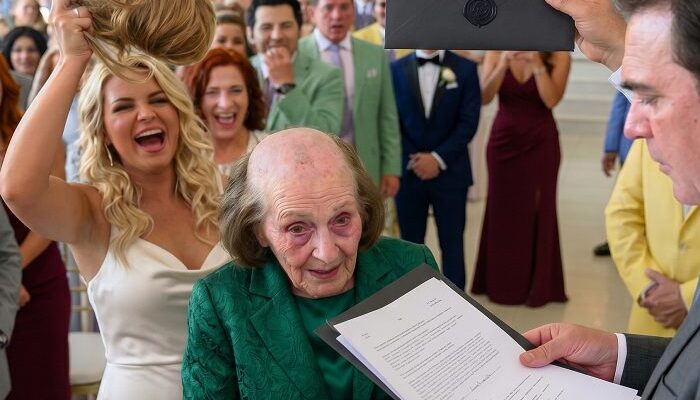
My daughter-in-law tore the wig from my wife’s head in the middle of my son’s wedding.
For a few unbearable seconds, the entire ballroom went silent.
No music.
No voices.
Nothing.
Then someone laughed.
That sound cut through the room like a blade.

Mary stood under the harsh wedding lights, my jacket draped over her shoulders, her trembling hands pressed to her chest as if she could hold herself together.
She had been fighting cancer in silence for months. Quietly. Bravely.
She never wanted pity. Never wanted attention. She only wanted to see her son get married without becoming a spectacle.
Jennifer knew. Lucas knew.
And yet it still happened.
My son stood frozen beside his bride—not in shock, but in shame. And that was worse.
Something inside me broke.
I stepped forward, took the microphone from Jennifer, and faced Lucas.
“I brought you a wedding gift,” I said.
The room fell even quieter.
I opened a black envelope I had carried for months.
Lucas saw the document and went pale.
Revocation of Property Transfer Agreement.
Jennifer frowned. “What is that?”
“It means the house you planned to move into… is no longer his.”
A wave of shock moved through the room.
Lucas panicked. “Dad, please—don’t do this here.”
I looked at Mary. She wasn’t angry. Just hurt.
And that was enough.
“You let your wife humiliate your mother in front of everyone,” I said quietly. “So yes. I will do this here.”
Jennifer scoffed and tossed the wig aside. “She’s overreacting.”
Mary flinched.
Just that small movement changed everything for me.
There was no turning back now. 👇👇👇
“You knew she was sick,” I said. “You mocked her appearance at the rehearsal dinner. You told the photographer to avoid her. You even said she would ‘ruin the aesthetic’ of your wedding.”
The bridesmaids dropped their gazes.
Lucas whispered, “Jennifer…”
She snapped toward him. “Don’t act innocent. You agreed.”
The room heard everything.
Lucas shut his eyes, and for a moment I saw the boy he used to be—the child who cried when Mary burned her hand making his favorite soup. Somewhere along the way, he had learned to trade kindness for acceptance.
Mary spoke at last.
Softly. Clearly.
“Lucas, I only wanted to be here for you.”
He looked at her—really looked—and shame broke across his face.
“Mom…”
She stepped back. “No,” she said gently. “Not tonight.”
I helped her down from the stage. No one laughed now. People moved aside in silence, some crying, some unable to look at Jennifer at all.
At the doors, Lucas followed us.
“Mom, please.”
Mary stopped, but didn’t turn.
“I raised you to protect people who are hurting,” she said. “Not stand beside the ones who hurt them.”
Then she walked out with me.
The wedding ended there.
By morning, everything had changed. Videos spread quickly. Jennifer’s image collapsed in hours. Guests began calling Mary with apologies. Three days later, Lucas came to our house alone, without his ring.
He stood on the porch holding a small blue box.
Inside were his childhood drawings—kept all those years.
“I forgot who loved me first,” he said, crying. “I don’t know how to fix it.”
Mary looked at him for a long time.
Then she opened the door.
Forgiveness didn’t arrive all at once. It never does.
But he stayed. He showed up. He drove her to treatment, cooked poorly, cleaned worse, and sat beside her without distraction. He apologized again and again—not for show, but because the truth finally weighed on him.
Months later, Mary stood in the garden with no wig, sunlight on her bare head, smiling as they planted roses together.
She looked beautiful—not because she looked like before, but because she finally felt unburdened.
And that black envelope?
People called it revenge.
It wasn’t.
It was protection.