THE DAY MY FAMILY TOLD THE WORLD I WAS IN PRISON WHILE I WAS ACTUALLY SERVING OVERSEAS
FOR FOUR LONG YEARS, my parents told the world I was locked behind prison bars… while I was actually thousands of miles away, risking my life serving in the military overseas. And when I finally came home wearing my Army uniform, they looked me in the eyes… and called the police, claiming I was a violent criminal.

“Stay in the truck,” Mr. Holloway whispered, his shaky fingers locking the doors. “Your mother just called 911… she told them an escaped prisoner is standing in her yard.”
My heart stopped.
Outside the windshield was the house I had dreamed about every single night for four painful years.
The fading white porch.
The cracked driveway where I used to ride my bike.
The old birdbath beside the mailbox.
Home.
At least… the place I once called home.
I was still wearing my Army uniform after returning from deployment overseas. Dust clung to my boots. My duffel bag rested on my lap. My discharge papers were folded carefully inside my jacket like proof that everything I survived was real.
For years, I replayed this moment in my head.
I imagined my mother running into my arms in tears.
I imagined my father hugging me tighter than ever before.
I imagined hearing someone say they were proud I made it home alive.
Instead, sirens screamed through the neighborhood.
Three sheriff’s deputies pulled up first.
Then neighbors slowly gathered outside like they were watching a tragedy unfold.
Teachers from my old school.
Families from church.
And then a local news van arrived, the cameraman rushing across the lawn with the hunger of someone chasing scandal.
I looked at Mr. Holloway, my chest tightening with disbelief.
“What did my mother tell them?”
He swallowed hard.

“She said you were dangerous. Said you’d been released from prison early. Said the military uniform was fake.”
The words hit harder than bullets ever had.
The air vanished from my lungs.
Then the front door creaked open.
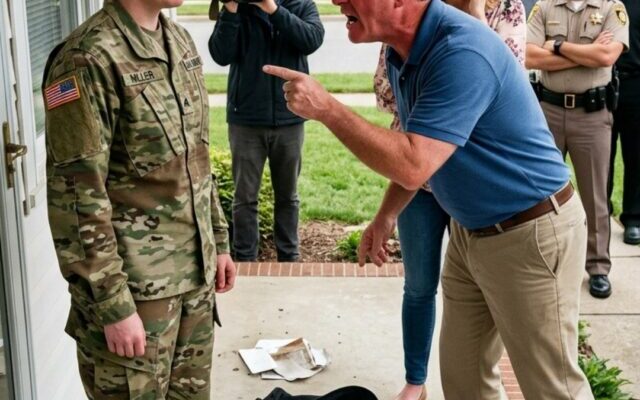
My mother stepped outside wearing her beige sweater, one hand pressed dramatically against her chest like she was the victim in some performance meant for the entire neighborhood.
Behind her stood my father, stiff and furious, gripping the chain lock stretched across the door.
“Sarah,” my mother called out loudly, making sure everyone could hear her, “please stop making this harder than it already is.”
The cameraman instantly swung toward me.
Sheriff Walker approached carefully.
“Everybody stay calm,” he said.
My voice trembled as I answered.
“I’m Staff Sergeant Sarah Mitchell. I just came home from overseas deployment.”
Whispers exploded through the crowd.
Mrs. Donnelly — my old middle school teacher — covered her mouth in horror.
Pastor Glenn looked pale enough to collapse.
Then my mother pointed directly at me.
“That uniform is part of her manipulation,” she said coldly. “She’s been lying her entire life.”
My hands shook as I reached slowly into my pocket.
“Sheriff, I can show you my military ID—”
“Don’t touch anything she gives you!” my father suddenly screamed from the doorway.
The entire street went dead silent.
And then… everything changed.
Mr. Holloway stepped out of the truck.
“That girl sent letters home every single month,” he said, his voice trembling with emotion. “I mailed every one of them after her parents refused to accept them.”
For the first time, my mother’s mask slipped.
Not guilt.
Not heartbreak.
Rage.
Pure, burning rage.
Then my father slammed the front door shut.
One lock clicked.
Then another.
Then another.
My own parents locked themselves inside the house while my father shouted through the door:
“If she wants everyone to know the truth so badly… then tell them what she buried!”
And suddenly, every single person standing there turned to stare at me.
👇👇👇
PART 2 🔥
A window upstairs flew open.
A black duffel bag crashed onto the porch.
My name was stitched across it.
At first I thought it was another setup.
I was wrong.
What came out of it made Sheriff Walker reach for his weapon—and made my mother scream at my father to run.
The sheriff stepped onto the porch.
“Sarah,” he said carefully, “is this your bag?”
“It used to be,” I said. “I haven’t seen it since basic training.”
My mother pounded the door from inside.
“Don’t open that!” she screamed. “She’s dangerous!”
Then the sheriff unzipped it.
No weapons.
No drugs.
No evidence of crime.
Just letters.
Dozens of them.
Every envelope in my handwriting.
Some rain-stained.
Some opened and taped shut again.
Others still stamped from Germany, Qatar, Afghanistan.
Mr. Holloway spoke quietly.
“They marked them return to sender.”
I stared at the house.
“You refused my letters?”
No answer.
The sheriff pulled out a folder.
His expression changed immediately.
“This is a power of attorney.”
My signature was on it.
Forged.
Below it were bank records, loan documents, and a deed transfer for my grandmo ther’s blue house on Cedar Lane.
My father cracked the door.
“She gave us permission,” he snapped.
“No, I didn’t.”
My mother’s voice cut through.
“You abandoned this family.”
“I served my country.”
“You left us with debt!”
“So you told everyone I was in prison?”
Pastor Glenn stepped back slowly.
Then quietly admitted, “Donna told the church she had fallen into addiction. We raised nearly seventy thousand dollars.”
My stomach dropped.
Seventy thousand.
Then an old pickup truck pulled in.
A man stepped out.
Walter Briggs.
The mortgage broker.
He looked at me and gave a thin smile.
“Well,” he said, “looks like the dead daughter finally came home.”
The word hit like a blow.
“Dead?” I whispered.
Sheriff Walker turned sharply.
“What do you mean?”
Walter shrugged.
“They filed paperwork saying she was missing and presumed dead overseas. That’s how they transferred everything.”
“That’s impossible,” I said. “The Army would notify next of kin.”
“They didn’t use the Army,” he replied. “They used forged documents, a willing pastor, and a town that already believed the story.”
Inside, curtains shifted.
My mother was on the phone.
Her lips formed three words.
Burn the garage.
“Burn the garage,” I repeated.
Sheriff Walker ran.
Smoke was already rising.
I moved first.
My father stumbled out of the garage coughing, holding a gasoline can.
He was tackled into the grass.
My mother ran out screaming, “Michael, no!”
Neighbors rushed in with hoses.
Firefighters arrived within minutes.
Inside the garage were half-burned documents.
My name across them.
And a box labeled in my mother’s handwriting:
SARAH ISSUE.
By midnight, the station was full of evidence.
Every letter I had ever sent.
Every photo.
Every military update.
Everything they had hidden.
They didn’t lose my mail.
They erased it.
They told people I was in prison.
They told the church I was addicted.
They took money in my name.
And they filed paperwork to declare me dead.
At first I thought I was returning home.
Instead, I had walked into a lie built around my disappearance.
That night they were arrested.
Fraud.
Forgery.
Arson attempt.
False statements.
Walter Briggs was caught the next morning with more forged documents.
The story spread through the town for weeks.
At first I hated it.
Then letters began arriving.
Apologies.
Truths.
Confessions.
The church returned the money.
My grandmother’s house was restored.
The first night I slept there, Mr. Holloway placed my mail in the box and said, “Welcome home, Sergeant Mitchell.”
I cried until I couldn’t breathe.
Months later in court, my mother looked at me and said, “You enjoyed humiliating us.”
I stood in uniform.
“No,” I said. “I survived you.”
They were sentenced.
Not enough.
But enough for me to finally exist without their lie holding me in place.
On Memorial Day, I spoke in town.
“I was never in prison,” I said. “But I was buried in a story. And silence builds cages for people who never deserved them.”
No one clapped immediately.
They listened.
That mattered more.
A little girl later asked, “Can girls be soldiers?”
I smiled.
“Yes. And they can come home too.”
That night, I opened every window in my grandmother’s house.
At the bottom of my bag was a letter I never sent.
I read it once.
Folded it.
Put it away.
Not because I was hiding.
But because the story was finally mine again.