The May sun over Los Angeles hung low and heavy, draping the city in a haze that made the asphalt shimmer like waves on water. Beyond the towering hedges and stone walls surrounding my Bel Air estate, heat rose in endless ripples. Inside my office, floor-to-ceiling glass reflected the afternoon light while the quiet hum of air conditioning kept the world outside at bay.
The gardens below had been sculpted into perfection. Every hedge was trimmed. Every rose bloomed exactly where it should. My inbox was filled with contracts and opportunities worth millions.
My name is Adrian Calloway.
For more than a decade, I built luxury hotels, corporate towers, and shopping centers across the country. The media loved calling me brilliant, ambitious, self-made. According to every measure of success, they were right.
Yet none of it meant anything anymore.
Success had consumed every hour of my life while slowly hollowing something out inside me.
I stood by the window staring at the flawless green lawn, the ivory roses, the endless blue edge of the infinity pool.
Everything looked perfect.
Everything felt dead.
Then one of the security screens blinked.
Someone was standing at the front gate.
Normally, security handled visitors long before they reached the property. Solicitors never made it this far.
But somehow, a small figure had slipped through.
I zoomed in.
A girl.
Twelve, maybe. Thin and exhausted-looking, with dark hair tied into a loose, messy ponytail. She wore a faded school polo that hung from her narrow shoulders. In one hand she carried a stretched grocery bag filled with oranges, heavy enough to tilt her sideways.
She wiped sweat from her forehead, steadied herself, and pressed the intercom button.
Ignoring her would have been easy.
I could have let the heat drive her to the next mansion and gone back to my spreadsheets and projections.
That was what the man I’d become usually did.
But something about her stopped me.
Her legs trembled beneath her. Her lips pressed tightly together as if she were fighting back tears.
For reasons I couldn’t explain, it cut through me.
I pressed the intercom.
“Yes?”
Even to me, my voice sounded colder than I intended.
She jumped.
“Good afternoon, sir. I’m sorry to bother you. My name is Camila.”
Her voice was soft but carried a quiet courage—the kind children develop when life asks too much of them too soon.
“I’m selling oranges. They’re very sweet.” She hesitated. “I’m trying to help pay for my mom’s medicine.”
In Los Angeles, stories like that weren’t unusual. Desperation often sounded rehearsed.
But this didn’t.
Her voice carried exhaustion, not performance.
“Stay there,” I said.
I left my office and stepped into the crushing heat.
When the gates slid open, she looked up at me with cautious hope.
“How much?” I asked.
“Five for three dollars, sir. Ten for five.”
I reached for my wallet.
Nothing except large bills.
I handed her a hundred-dollar note.
“I’ll take all of them.”
Her eyes widened instantly.
“All of them? Sir, I don’t have enough change.”
“I don’t need change.”
Then I looked at her more carefully.
“You look like you’re about to pass out.”
She shifted her feet.
“I skipped breakfast.”
Something inside me cracked.
“Come inside,” I said quietly. “You’re not leaving like this.”
She hesitated, studying me.
Then she nodded.
Continued from the first comment 👇👇

Her worn sneakers left faint dusty marks across the marble floors as she stepped into the house. Her eyes moved slowly over the soaring ceilings and curved staircase.
“Do you live here by yourself?” she asked.
“Yes.”
For some reason, that answer seemed to make her sad.
“Sit down,” I said. “I’ll get you something to eat.”
I moved through the kitchen faster than I ever had before a board meeting, throwing together sandwiches, fruit, juice, and protein bars.
Oddly enough, taking care of her suddenly felt important.
Necessary.
When I returned, she wasn’t sitting at the table.
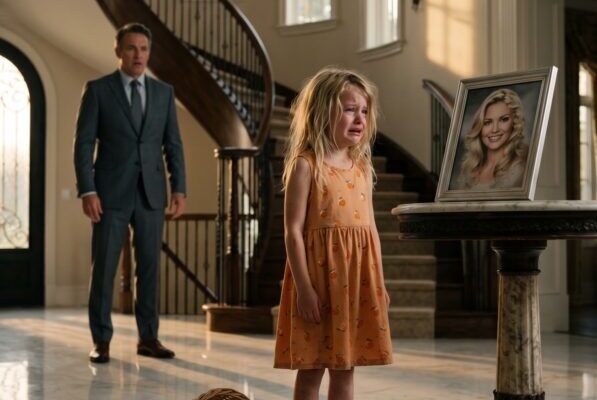
She stood near the staircase holding a silver picture frame.
The one picture I had never managed to put away.
Elena.
I had taken it years ago in a small downtown park, back when life still felt simple—before she vanished without explanation and left me with questions I could never answer.
Camila stared at the photo.
Then her shoulders began to shake.
“Sir…” she whispered.
Her voice broke.
“Why do you have a picture of my mom?”
The world seemed to tilt.
“What did you say?”
“That’s my mom,” she whispered. “She looks younger there… happier. But that’s her. Elena Rivera.”
My heart slammed against my chest.
I looked from the photograph to the little girl standing in front of me.
And suddenly I saw it.
The same eyes.
The same smile.
The same fire hidden beneath sadness.
“Your mother’s name is Elena Rivera?”
Camila nodded, tears slipping down her cheeks.
“Sometimes she says your name when she thinks I’m asleep,” she said softly. “Adrian.”
The years crashed into me all at once.
Twelve years old.
Ten years since Elena disappeared.
“Take me to her.”
My voice barely sounded like my own.
The drive east felt endless.
The luxury homes and polished streets disappeared, replaced by cracked sidewalks and aging apartment buildings.
Camila directed me through narrow streets until we stopped outside a worn brick complex.
“Third floor,” she said quietly.
Inside, the air smelled of damp walls and old paint.
The apartment contained almost nothing.
A mattress.
A hot plate.
A few scattered belongings.
And lying on the bed was a woman trying to sit upright.
My breath caught.
“Elena.”
She stared at me as though she’d seen a ghost.
“Adrian?”
Camila rushed to her side.
“Mama, he’s the man in the picture.”
I knelt beside the bed.
“Why did you leave?”
Tears rolled down Elena’s hollow cheeks.
“Your mother came to me,” she whispered weakly. “She said I’d ruin your future. She said you didn’t want a child.”
Cold fury spread through me.
“She lied,” I said. “I searched for you.”
Elena shook her head.
“I was pregnant. I was scared.”
I looked toward Camila.
Twelve years old.
My daughter.
“We’re leaving,” I said.
And for the first time in years, I knew exactly what mattered.
The doctors later diagnosed Elena with severe pneumonia and anemia.
The next morning, the DNA test confirmed what I already felt in my heart.
Camila was my daughter.
When I told her, she smiled softly and wrapped her arms around me.
“I love you, Dad.”
Three words.
Three words that rebuilt something money never could.
I had spent my life building skyscrapers tall enough to scrape the clouds.
But the most important thing I ever built started the moment a tired little girl stood at my gate and asked:
“Sir… would you like to buy some oranges?”