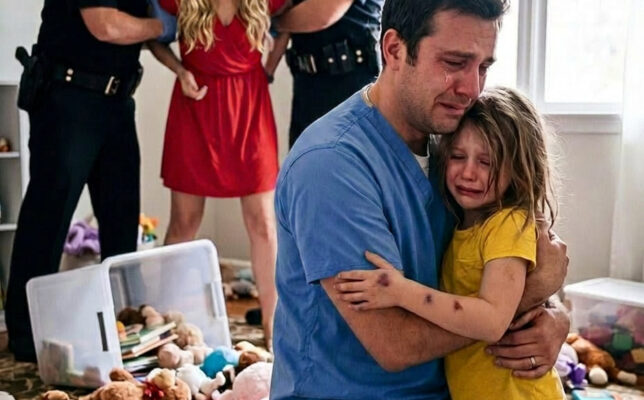
Harper first cried when we were alone together three weeks after I married her mother.
At first, I told myself it was normal. She was seven years old, old enough to understand that her world had changed forever and young enough to have no control over it. A new house. A new family. A strange man suddenly walking through her hallway.
Children cry when life changes.
I worked as an ER trauma nurse at the University of Colorado Hospital. I had spent years learning how to recognize fear before patients could explain it. I thought I knew what pain looked like.
I thought I knew people.
When I knelt in front of Harper and asked softly, “What’s wrong, sweetheart?” she shook her head immediately.
Not like a child denying sadness.

Like someone terrified of saying the wrong thing.
Before Clara entered my life, my world had been simple: long shifts, coffee, late nights, and loneliness. Then Clara appeared—beautiful, confident, warm. She talked about building a future, about having a home, about becoming a family.
I wanted to believe her.
We married after six months in a small courthouse ceremony. Clara looked flawless in cream-colored silk, but it was Harper who caught my attention.
She wore a blue dress and carried a small bouquet of daisies.
She looked less like a flower girl and more like a witness.
Three weeks later Clara left on a business trip, leaving Harper and me alone for the first time.
The moment the front door closed, I felt something strange.
The house relaxed.
The tension disappeared so completely that it almost felt alive.
Harper relaxed too.
We ate cereal on the couch and watched animated movies beneath a blanket. For the first time since I had met her, she laughed freely. She talked about her stuffed fox, Scout, and asked endless questions about my job.
For a few hours she looked like an ordinary child.
Then I noticed tears rolling silently down her face.
I paused the movie.
“What happened?”
“Nothing,” she whispered.
After a long silence she finally said, “Mom says you’ll get tired of us. She says men always leave because I’m too much work.”
My chest tightened.
Some wounds don’t bleed.
“Harper,” I said quietly, “look at me. I’m here. I’m not going anywhere.”
That night I heard crying.
Not loud sobbing.
Small, muffled sounds.
I found Harper sitting on her bedroom floor hugging Scout.
“Bad dream?” I asked.
She shook her head.
“Mom says I can’t talk about the old Harper,” she whispered. “If I do, the fire will come.”
Cold fear settled in my stomach.
A few days later I saw bruises on her arms while helping her put on a sweater.
Finger-shaped bruises.
“Harper,” I said carefully, “did someone hurt you?”
She pulled down her sleeves instantly.
“I fell.”
I knew she was lying.
Children lie differently than adults. Adults lie to protect themselves.
Children usually lie to protect someone else.
While Clara was away again, I searched the house.
I hated doing it, but every instinct I had screamed that something was wrong.
I found hidden sleep medication Harper had never been prescribed.
Then I found a stuffed rabbit hidden beneath toys in her room.
One ear was torn.
Dark brown stains covered the fabric.
Dried blood.
I photographed everything.
That night Harper barely touched her dinner.
“My stomach hurts,” she whispered.
Clara smiled sweetly and told me to get medication from the kitchen.
I watched her force Harper to swallow pills.
Later, after Clara went to sleep, I found Harper sitting in the dark.
She held the rabbit in her lap.
“What happened to it?” I asked gently.
Harper stared at the floor.
“Mom said I was being too loud,” she whispered. “She pushed it against my face and told me to bite down so nobody would hear me cry.”
The words felt like a knife.
I pulled her into my arms.
No child should ever have to earn the right to be heard.
A few days later Harper handed me Scout.
“I want you to look inside,” she whispered.
Hidden beneath the fox’s fur was a small flash drive.
I plugged it into my laptop.
The first video made my blood run cold.
Clara sat beside Harper, speaking to her sharply.
“Say Ethan touched you.”
Harper was crying.
“But he didn’t!”
“Say it.”
Clara grabbed her shoulders.
“Tell the camera what he did.”
There were more videos.
Older videos.
Different men.
Different rehearsed stories.
I sat frozen.
This wasn’t anger.
This wasn’t discipline.
This was strategy.
I called my cousin Lucas, a detective.
By morning he had discovered enough to turn my fear into horror.
Clara had used multiple identities. She had a history of relationships ending in tragedy and insurance payouts.
Then I found a brand-new life insurance policy under my own name.
One million dollars.
Attached was a forged psychiatric report claiming I suffered from depression and suicidal thoughts.
Suddenly everything made sense.
The false accusations.
The manipulation.
The fear.
I wasn’t being framed by accident.
I was being prepared.
Then Clara made her move.
I woke at three in the morning smelling smoke.
The garage was on fire.
I ran into Harper’s room, grabbed her, and carried her outside as smoke rolled through the house.
Minutes later Clara arrived, crying and screaming with perfect panic.
Too perfect.
Investigators later found evidence of accelerant near the garage.
Someone had set the fire.
Police arranged a sting operation.
Believing she was hiring someone to eliminate me, Clara met with an undercover officer carrying cash.
“Make it look like suicide,” she said calmly.
Moments later officers surrounded her.
The handcuffs clicked shut.
She looked at me across flashing blue lights.
“You’re a dead man,” she whispered.
I simply looked back at her.
For the first time, I wasn’t afraid.
The trial lasted weeks.
Clara cried in court. Claimed she was innocent. Claimed I had manipulated everyone.
Then Harper testified.
She sat holding Scout while her feet dangled above the floor.
Her voice shook.
But it never broke.
She talked about the rabbit.
About being forced to stay quiet.
About being taught to lie.
The jury returned two hours later.
Guilty.
Months afterward Harper and I moved to a farmhouse outside Boulder.
The old house was gone.
The fear was gone too.
One afternoon we sat beside a creek watching a small frog cling to a stone.
“Do you think he’s scared?” Harper asked.
“Maybe,” I said.
She slipped her hand into mine.
“Mom thought she was burying us, didn’t she?”
I looked at the little girl who had saved both our lives with a secret hidden inside a stuffed fox.
“She did.”
Harper smiled.
“But she forgot something.”
“What?”
I smiled back.
“She forgot that when you bury a seed…”
Harper finished softly:
“…it grows.”
And for the first time in a very long time, I stopped listening for danger.
I listened to laughter.