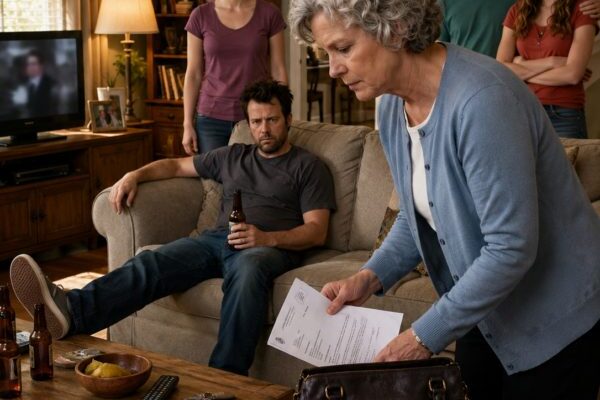
I asked my son-in-law to turn the music down. In front of all his friends, he smirked, lifted his beer, and said, ‘This is my house, you bitter old woman. If you don’t like it, the door’s right there.’
What hurt most wasn’t his cruelty.
It was my daughter sitting beside him, staring at her phone like I didn’t even exist.
I looked down too. But instead of wiping away tears, I slowly opened my purse, pulled out the document I had carried with me for twenty-three days, and laid it carefully on the table.
The silence that followed was heavier than the music ever was.

‘If you’re so miserable here, then leave,’ Tyson snapped again, boots propped on the dining table I spent eleven exhausting months paying off after my husband died.
My name is Joanne Miller. I’m sixty-two years old, and every inch of that house was built with my sacrifice.
No one handed it to me. No one rescued me. After my husband passed, I raised my daughter Shelby alone while drowning in grief, debt, and fear. I worked endless nights behind a sewing machine—hemming uniforms, fixing torn jackets, stitching wedding gowns until my fingers cramped and bled—just to keep the lights on and the mortgage paid.
Some nights I worked until two in the morning with swollen hands, aching legs, and cold coffee beside me. That house cost me decades of my life.
When Shelby first brought Tyson home, I thought she’d found someone kind. He called me “Ma’am,” carried groceries inside, smiled politely. But little by little, the mask slipped.
First came the messes. Then the disrespect. Then the entitlement.
He started speaking about my home as though my sacrifices meant nothing.
‘We should remodel this room.’
‘We could tear this wall out.’
‘Your sewing workshop wastes too much space.’
We.
Like he had earned any part of it.
And while Tyson became louder, crueler, more controlling… my daughter became quieter. Every time he crossed a line, Shelby defended him. Said he was stressed. Said I should be grateful I wasn’t alone.
Grateful.
In my own home.
That night, after Tyson humiliated me in front of everyone, I turned off the stove without eating and sat alone upstairs in the dark. I stared at my hands—the same hands that built our entire life—and for the first time ever, I felt unwelcome inside my own walls.
The next morning, I opened an old notebook and added up every dollar I had ever given Shelby and Tyson for their emergencies, bills, late payments, and ‘temporary setbacks.’
Five thousand.
Eight thousand.
Twelve thousand.
Twenty-five hundred.
By the time I finished calculating, my chest felt tight.
$153,000.
A lifetime of hard work handed over piece by piece.
Then, two days later, while helping a customer in my workshop, I looked out the window and saw Tyson outside with a man in a business suit, proudly showing him around my backyard like he already owned the place.
‘Plenty of space back here,’ Tyson said confidently. ‘The workshop comes with the property.’
That was the moment something inside me finally shattered.

Because I realized he wasn’t just disrespecting me anymore.
He was planning to take everything I had left.
And what I did next changed all of our lives forever. ☹️😣
The story continues in the first comment… ⬇️⬇️⬇️”
The stranger nodded while Tyson proudly described renovations to a house that wasn’t even his.
That was the moment something inside Joanne finally gave out.
Not with shouting.
Not with tears.
Just quietly.
Forever.
When she confronted him, Tyson barely looked at her.
“Relax,” he scoffed. “You’re acting crazy again.”
Crazy.
That word stayed with her all night.
The next morning, Joanne called her nephew Derrick, a lawyer in Las Vegas. After listening carefully, he asked one question:
“Aunt Joanne… whose name is on the deed?”
“Mine.”
“Only yours?”
“Yes.”
A long silence followed.
Then Derrick said softly, “He has no legal right to that house.”
Two days later, Joanne walked out of Derrick’s office with eviction papers hidden inside her purse.
For three weeks, she said nothing.
And Tyson only got worse.
Louder.
Crueler.
More convinced the house belonged to him.

Then came the final night.
Music thundered through the walls while Tyson and his friends drank and laughed in the living room. Joanne stepped out quietly and asked if they could lower the volume.
Tyson smirked.
“This is my house,” he announced loudly. “You’re just an old woman who forgot her place.”
The room filled with awkward laughter.
Shelby looked ashamed—but stayed silent again.
Joanne didn’t argue.
She simply placed an envelope in front of Tyson.
His smile disappeared the second he opened it.
“You’re evicting me?”
“I’m reminding you whose house this really is.”
Shelby burst into tears.
“If he leaves, I leave too.”
Years ago, that threat would have broken Joanne.
This time, she only nodded.
“Then that’s your choice.”
After that, Tyson suddenly became polite again—offering groceries, fixing things around the house, calling her “Ma’am” like before. But Joanne finally saw it for what it was: desperation.
Then one night, she found a mortgage application hidden in Shelby’s purse.
Her house had been listed as collateral.
Tyson and Shelby had planned to borrow against her home without telling her.
That betrayal cut deeper than any insult.
When confronted, Shelby finally broke down. Through tears, she admitted Tyson had manipulated her for months, convincing her the house should belong to them anyway.
And then she confessed the truth she’d been hiding:
She was afraid of him.
The next morning, Shelby told Tyson it was over.
He exploded.
Shouting. Breaking dishes. Smashing a lamp against the wall.
But before things could get worse, there was a knock at the door.
Derrick stood outside with two police officers.
And just like that, Tyson’s confidence vanished.
Within an hour, he was stuffing clothes into a suitcase, muttering threats that sounded smaller with every step.
By sunset, he was gone.
And for the first time in years, the house felt peaceful again.
Months later, Shelby started therapy. Joanne bought herself a brand-new sewing machine. Together, mother and daughter repainted the workshop and planted flowers in the yard.
One evening, Shelby quietly took her mother’s hand and whispered through tears:
“I should’ve protected you.”
Joanne squeezed her fingers gently.
“We both deserved better.”
And sitting there in the quiet home she had fought so hard to keep, Joanne finally understood something:
People don’t lose themselves all at once.
It happens slowly.
One silence at a time.
One compromise at a time.
Until one day, you barely recognize your own life.
And sometimes healing doesn’t begin with revenge.
It begins the moment you finally decide you deserve peace.