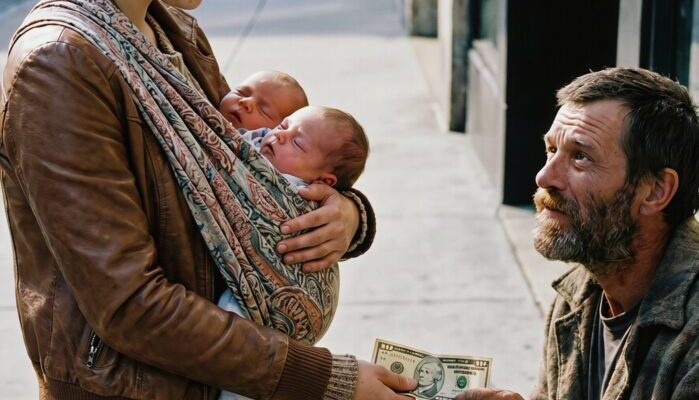
I gave away my last $10 in 1998… and today, a lawyer walked into my office with a box that made my whole world fall apart.
I was only 17 when I had my twins.
Seventeen. Completely broke. Running on empty.
And still pushing myself to be an honor student—because I clung to this fragile hope that if I just worked hard enough, life would eventually notice me.
But my parents didn’t.
To them, I had ruined everything. They shut me out of their lives completely—no support, no home, no safety net.
By November 1998, I was barely holding it together.
A full-time student. A mother of two tiny babies. Carrying them everywhere in a worn-out sling against my chest. Surviving on instant noodles and late-night library shifts.

That night, the rain in Seattle felt endless. Cold. Heavy. Unforgiving.
And in my pocket? My last $10. That was it.
Bus fare. Food. Maybe three more days of scraping by.
Then I saw him.
An older man sitting under a rusted awning, drenched to the bone.
He was shaking so badly it hurt to look at him. No sign. No voice. Just… invisible to the world.
I knew that kind of invisible.
Before I could even think it through, I took that last $10 and pressed it into his trembling hand.
“Please… get something warm,” I whispered.
He looked at me—really looked at me. Like I mattered.
And I don’t know why, but I asked, “What’s your name?”
There was a pause. A quiet moment that felt heavier than the rain.
Then he said softly, “Arthur.”
I nodded, as if that small detail meant something.
Then I turned and walked three miles home in the pouring rain, holding my babies close, shielding them the best I could.
I remember feeling so foolish.
Like kindness was something I simply couldn’t afford.
Twenty-seven years went by.
I’m 44 now. My girls are grown… but life never really got easier.
Two years ago, one of them got seriously ill. Surgeries. Treatments. Bills that never stopped coming, no matter how hard I fought.
And now… I’m drowning again.
This morning, I sat at my desk, staring at yet another overdue notice, feeling completely defeated… when a man in a charcoal suit walked in.

“Are you Nora?” he asked.
My chest tightened.
He placed an old, weathered box in front of me.
“I represent the estate of Arthur,” he said. “He spent years trying to find you.”
My heart stopped.
Arthur…
The man I met for less than a minute in 1998.
“He asked me to give this to you personally.”
The room felt like it was spinning.
The box creaked softly as I opened it…
And the moment I looked inside— I completely broke down.
The man I thought was just a stranger… wasn’t who I believed at all.
The story continues in the first comment ⬇️⬇️⬇️
Inside was a worn leather notebook.
I flipped it open.
The first entry stopped me cold:
“Nov. 12, 1998 — Girl named Nora. Two babies. Gave me $10. Don’t forget this.”
My vision blurred.
Page after page, I saw entries—different dates, different people—but my name appeared again and again.
“Never forget Nora.”
“Must find Nora and her girls.”
“Hope they’re safe.”
I couldn’t speak.

Carter explained that Arthur hadn’t always been homeless. He had once owned a small business, but after it failed, he lost everything.
“That night you met him,” Carter said, “changed him. He said it was the first time in years someone treated him like he mattered.”
Arthur rebuilt his life slowly—taking odd jobs, saving what little he could, eventually securing housing.
Every year, on the same date, he wrote:
“Still looking for Nora.”
I asked how he finally found me.
Carter said it was because of a fundraiser I had posted online for Mae’s medical bills.
Arthur saw it. He recognized my name—and my daughters.
But by then, his health was failing.
So he did the only thing he could.
He made a will.
“Take another look in the box,” Carter said.
Inside, beneath the notebook, was a cashier’s check.
I stared at the number.
$62,000.
My breath caught.
“That’s everything he saved,” Carter said gently.
I shook my head in disbelief.
“Why?” I whispered.
“Because,” Carter replied, “he believed that money never belonged to him. It belonged to the moment that changed his life.”
I broke down.
Not because of the amount—but because of what it meant.
That $10 I once thought I couldn’t afford… hadn’t been lost.
It had stayed with him for nearly three decades.
That night, I told Lily and Mae everything.
By the time I finished, Mae was in tears.
“All of this… from $10?” she whispered.
I shook my head.
“No,” I said softly. “From being seen.”
In the weeks that followed, everything changed.
For the first time in years, I wasn’t choosing which bill to delay.
Mae’s medical debt disappeared.
Her treatments continued—but now, we could breathe.
For the first time in decades, I felt free.
A few days later, I went to find someone.
Mrs. Greene.
When she opened the door, she recognized me instantly.
“Nora?”
We sat together, just like old times. I told her everything.
Then I placed an envelope in front of her.
“I never paid you back,” I said.
She smiled gently.
“You finished school. That was enough.”
I shook my head.
“You gave me more than that.”
She studied me, then accepted the envelope.
That night, I opened Arthur’s notebook to a blank page.
For a long time, I just stared at it.
Then I began to write:
“April 3 — Paid Mrs. Greene back for helping me raise my daughters.”
It was simple.
But it meant everything.
From that day on, I continued.
Small acts.
Quiet kindness.
Helping where I could—without expecting anything in return.
Because now, I understood.
It was never about the amount.
It was about the moment.
One afternoon, Mae watched me writing.
“You’re doing what Arthur did, aren’t you?” she asked.
“I’m trying,” I said.
She smiled.
“I think he’d like that.”
A week later, I visited Arthur’s grave.
I stood there for a long time.
Then I took out a ten-dollar bill and placed it gently at the base of his headstone.
“I found you,” I whispered. “Just like you found me.”
For years, I believed kindness was something I couldn’t afford.
I was wrong.
Because sometimes…
it doesn’t disappear.
It waits.
And when it returns—
it changes everything.