“Daddy, Look at His Music Box”—The Next Hour Revealed a Family Secret Hidden for 40 Years.
The evening crowd inside Grand Central Terminal surged forward like a restless river, carrying thousands of lives in its relentless current.
Beneath the glowing golden ceiling, travelers hurried past one another in a blur of motion—suitcases rattling over polished marble floors, coffee growing cold in hurried hands, phones pressed tightly to ears as urgent conversations dissolved into the endless echoes of train announcements. Faces passed like shadows. Eyes met for only a heartbeat before moving on. In a place built on reunions and farewells, most people were consumed by a single thought: the next destination.
Julian Whitmore was no different.

At forty-two, he had become the kind of man people recognized instantly, even if they couldn’t immediately remember why. His name was engraved on hospital wings, etched onto scholarship plaques, listed on charity boards, and featured in glossy business magazines. As the founder of Whitmore Development Group, he had spent years restoring New York’s most treasured historic buildings. The world saw him as generous. Successful. Visionary.
Yet that evening, he felt hollow.
His donors’ dinner was about to begin without him. His assistant had just texted about another contract delay. Deadlines pressed against his mind from every direction. Beside him, his seven-year-old daughter Clara struggled to match his pace, her small fingers wrapped tightly around his hand as if afraid of being swept away by the crowd.
“Daddy,” Clara asked breathlessly, “are we going to be late?”
Julian glanced at his watch and forced a smile.
“Only a little,” he said. “We’ll still make the speech.”
As he hurried forward, the station became little more than background noise. He barely noticed the violinist pouring his heart into a melody near the staircase. Barely noticed the woman arranging flowers beneath the grand clock. Barely noticed the elderly man sitting alone beneath the shadow of Platform Seven.
Most people didn’t notice him at all.
The old man sat quietly beside a battered suitcase scarred by time. His white beard was uneven, his weathered coat far too thin against the cold drafts that slipped through the opening doors. A cardboard cup rested near his worn shoes, but he never lifted it, never called for help, never asked for a single coin.
He simply watched.
Watched thousands of strangers pass him by.
There was something heartbreaking in his gaze—as though he had once believed someone would stop, someone would recognize him, someone would remember. But after years of disappointment, hope had slowly drained away, leaving only silence behind.
Julian walked past without a second glance.
Then Clara stopped.
Her hand tugged sharply against his.
“Daddy.”
Julian turned, impatience flickering across his face.
“Clara, sweetheart, we really have to go.”

But she wasn’t listening.
Her eyes were fixed on the old man.
Not on the frayed gloves covering his hands.
Not on the exhaustion etched into his face.
Not on the cardboard cup beside his feet.
She was staring at something hidden beneath his coat.
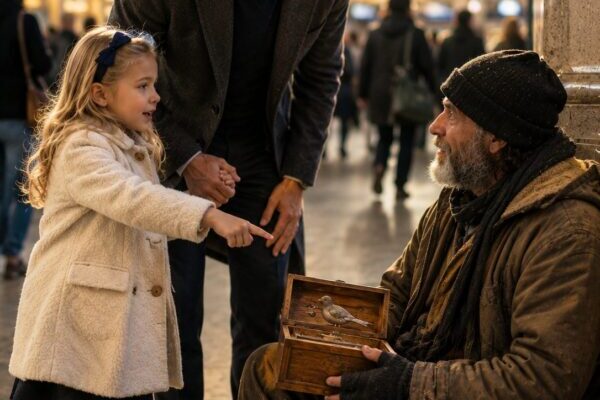
“Daddy,” she whispered, her voice suddenly filled with wonder, “look at his music box.”
Julian frowned and looked closer.
Resting carefully in the old man’s lap was a tiny wooden music box. It was no larger than a sandwich, darkened by age and worn smooth by countless years. The corners were chipped. A faded blue ribbon held it closed. Yet the old man’s hand rested protectively over it, as though it contained something far more precious than gold.
“Clara,” Julian said softly, “we shouldn’t stare.”
“But Daddy…”
Her voice trembled.
“It has the same bird.”
Julian blinked.
“What bird?”
She pointed.
“The little silver bird. Just like the one in your drawer.”
The words struck him like a sudden gust of icy wind.
His breath caught.
His heart skipped.
And for a brief, impossible moment, the roar of Grand Central faded into silence. 👇👇👇
At home, hidden inside a velvet pouch, Julian kept the only piece of his past—a broken silver swallow charm said to belong to his birth family. Through every chapter of his life—school, marriage, heartbreak, success, and fatherhood—it had never left his side. Only Clara knew about it.
When she pointed at the old man’s music box, Julian’s heart stopped.
A tiny silver swallow sat on its lid.
Not similar.
The same.

His throat tightened as he stepped closer.
“Excuse me,” he said softly.
The old man instinctively pulled the music box to his chest.
“I’m not causing trouble,” he muttered.
“That’s not why I stopped.”
Clara smiled shyly. “Your bird is beautiful.”
The old man’s face softened. “It belonged to my wife. She believed swallows always found their way home.”
Julian’s hands trembled. He pulled the silver charm from his wallet and opened his palm.
The moment the old man saw it, all the color drained from his face.
“My daughter had the other half,” he whispered. “My little girl.”
“What was her name?” Julian asked.
“Mara.”
The name hit Julian like a forgotten memory.
“Did she have a son?”
The old man stared at him.
“Yes. Samuel. Born April 18, 1984.”
Julian felt the world tilt beneath him.
That was his birth date.
Samuel was the name buried deep in his adoption records.
Tears filled the old man’s eyes as realization dawned.
“Samuel?”
Julian nodded.
For a long moment, neither spoke.
Then the old man whispered the words he had carried for forty years:
“My grandson.”
Around them, the station roared on, unaware that beneath Platform Seven, a family lost to tragedy had finally found its way back together.