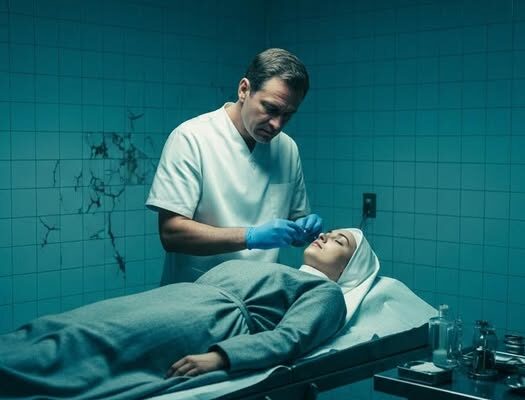
Camilo had worked at Puebla’s central morgue for over fifteen years, and in all that time, almost nothing had ever made his pulse race. But tonight was different. Tonight, the body on the frozen steel table was not just another corpse. It was a nun.
The young woman still wore her black habit, perfectly arranged over her slender frame. Her face was calm, almost radiant, as though she were merely asleep after a long day of prayer rather than dead. She had been brought from a convent on the city’s outskirts with orders to perform an autopsy—because no one could explain why she had died so suddenly.

“Doctor… doctor, come look at this,” Camilo said, his voice breaking as he instinctively stepped back, as if the stretcher itself had shoved him.
Doctor Esteban Fonseca looked up from the table of instruments. He had seen almost everything in his years at the morgue. But the sight before him caused a shiver he could not ignore.
“What is it, Camilo?” he asked cautiously.
“There’s an opening in the fabric… on her back. I think there’s… a tattoo,” Camilo replied, his voice faltering.
Fonseca frowned. “Not necessarily unusual. Not all who enter a convent come as children. Some have lives before their vows.”
Even he sounded unsure, though. Approaching, he saw a dark mark peeking through a tear in the habit. Without a word, he and Camilo carefully turned the body over. Fonseca offered a quick prayer, a reflex he could not ignore when a corpse demanded more respect than usual, then requested scissors.
He cut through the fabric and froze. It was not a tattoo. It was a message, written directly on the nun’s pale skin in trembling but legible letters:
“Do not perform the autopsy. Wait two hours. What you seek is in the pocket of my habit.”
Camilo crossed himself, whispering, “No… it can’t be.”
Fonseca ran a cautious finger over the letters, as though questioning his own eyes. Then, following the instructions, Camilo reached into the habit’s pocket. At first, he found nothing. But in the second pocket, his fingers brushed against a small, hard object: a USB drive.
Outside the room, the morgue sounded as always—metallic wheels, distant footsteps, the hum of refrigerators. But inside, the atmosphere had shifted. Fonseca inserted the drive into an old computer in the adjoining room, while Camilo kept his eyes fixed on the body, as if fearing the nun might rise at any moment.
On the screen, she appeared: the same pale face, the same habit, the same cross hanging from her neck. She was seated on a simple bed, dimly lit, her eyes wide with fear.
“If you are watching this,” she said, her voice ragged, “it is because my body has already arrived at the morgue… or because something worse has happened to me.”
A chill ran down Camilo’s spine.
“I don’t have much time,” the nun continued. “Please, do not trust the Mother Superior. She is not who she claims. Do not—”
A sudden, violent banging at the door interrupted her words. She turned in terror, and the video abruptly cut off. The silence that followed was heavy, almost suffocating.
“We need to call the police,” Fonseca whispered.
Before he could move, three sharp knocks sounded, followed by a pause, then three more. Fonseca approached the morgue’s main door, heart pounding, and froze as he opened it.
Standing there was a woman in her sixties, wearing an impeccable habit, a crucifix resting on her chest, and a gentle smile that offered no comfort.
“Good evening, son,” she said softly. “I’ve come to say goodbye to Sister Inés.”
Fonseca felt a shiver run from the back of his neck to his waist. The Mother Superior had arrived. His instincts screamed: do not let her in.
The night stretched on, each passing second heavier than the last. Secrets of the convent, long hidden, began to surface, interwoven with the young nun’s mysterious message. Ordinary reality blurred with the inexplicable, creating an unsettling story where the line between life, death, and the supernatural became nearly impossible to discern.